Claude Partner Network memberAI, engineered for the enterprise
Financial services

The member services agent a credit union can actually put live.

A member asks your chat channel whether skip-a-pay applies to her auto loan. The correct answer lives in a program document your team revised last quarter. Whether an AI agent can find that document, cite it, and know when to hand off to a person is the entire question of whether it belongs in front of members.

Where a wrong answer becomes a complaint

You are not deciding whether to adopt AI. You are deciding whether a piece of software gets to speak for your credit union about fees, rates, holds, and loan terms. That is a different decision, and it is the one a VP of Risk or a COO actually signs.

This is also not an SR 11-7 story. NCUA-supervised credit unions do not receive OCC model risk letters, and importing a large bank's model governance apparatus wholesale would bury a three-person compliance team. But the duty of care is the same. A wrong answer about a fee or a dispute is the kind of thing that ends up in a member complaint, and complaints about federally insured credit unions have a well-worn path to the NCUA Consumer Assistance Center. Your examiner will not ask what model you used. They will ask how you supervise a channel that answers members in your name.

The honest constraint is capacity. A credit union with 400 employees carries an enterprise-grade obligation to members with a fraction of an enterprise compliance staff. The design below is built for that gap, not around it.

Ground every answer in your own paper

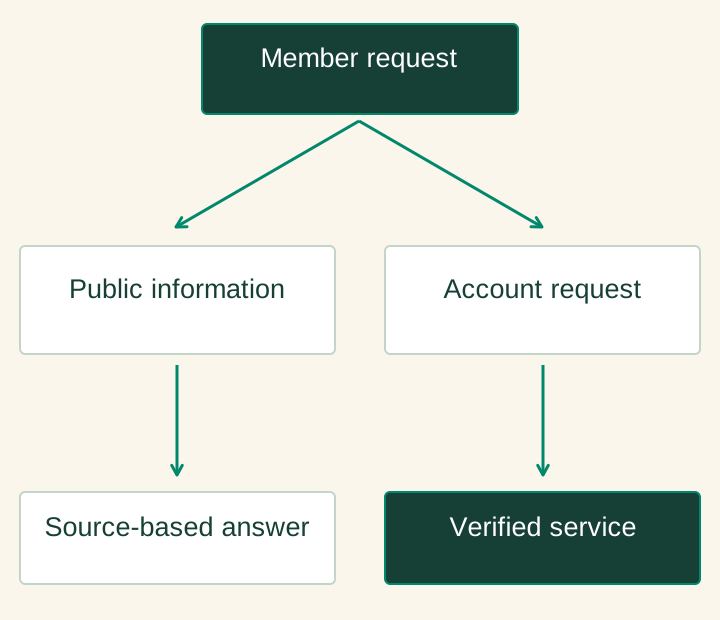
The documents already exist: the fee schedule, the membership agreement, the Truth in Savings disclosures, the loan policy, the skip-a-pay program terms. A governed agent retrieves from those documents and only those documents, and every answer arrives with the source attached. When a member asks about the courtesy pay limit, the response quotes your current fee schedule and says which document it came from.

The rule that makes this safe is the refusal rule. If the answer is not in the document set, the agent says it does not know and routes to staff. It never fills the gap from general training. And when your board changes a fee in March, re-indexing the documents changes the agent's answers in March, with no silent drift between what the agent says and what your disclosures say.

Open-ended chatbot

  • Answers from general model knowledge
  • No source shown to member or staff
  • Keeps quoting the old fee after a policy change
  • Equally confident when it is wrong

Grounded member agent

  • Retrieves from your fee schedule and disclosures
  • Every answer cites the source document
  • Policy updates propagate on re-index
  • Declines and escalates when no source exists
The difference is not intelligence. It is whether the answer can be traced to a document you published.

Bounded actions, and a hard line at anything consequential

Write down what the agent may do, and keep every item on the list reversible. Scheduling a callback, sending the current fee schedule, starting a membership application, answering branch hours from your published pages. All fine. Changing a rate, waiving a fee, moving money, or characterizing a loan decision is off the list, permanently, no matter how capable the model becomes.

Escalation is a feature, not a failure mode. Hardship language, dispute or complaint wording, fraud indicators, or any question about a member's specific account terms triggers a handoff to staff, with the conversation context carried over so the member does not repeat themselves. The escalation reason is logged, which matters later.

  • Written action list. Every action the agent can take is enumerated, reversible, and approved by compliance before launch.
  • Escalation triggers, not vibes. Specific conditions route to a human, and each handoff records why it fired.
  • A person is always reachable. The member can ask for staff at any point and the agent complies immediately.
Member questionPolicy retrievalCited draftGuardrail checkAnswer or escalate
Every response passes a guardrail check before it reaches the member. Anything consequential exits to staff.

Keep the transcript. You will be asked for it.

Every conversation is retained in full: the member's question, the passages the agent retrieved, the answer with its citation, and any escalation with its reason. The record lives under your existing retention schedule, alongside your call recordings, and it is readable by a compliance officer, not just an engineer.

Supervision then looks like something your team already does. Compliance samples transcripts on a schedule, the same muscle as call center QA, and flags anything that should have escalated but did not. When an examiner asks how this channel is monitored, you produce the transcript log and the sampling record. This is what Governed-by-Design means in practice: the deployment is designed to support your compliance program from the first conversation, rather than retrofitted after a finding. No one should promise you a compliance guarantee, and we do not. We build so the evidence exists.

A path a small team can actually run

Start narrow. One document set, one channel, one measurable outcome. Our engagements follow Discover, Design, Build, Govern, Scale, and for a credit union the Discover step is usually a week of reading your disclosures and your complaint log to find the questions members ask most and the answers that go wrong most often.

The free Claude Readiness Assessment tells you whether your document set and your team are ready before anyone commits budget. From there, a Governed Pilot runs at fixed scope with a success guarantee: we agree on one criterion up front, and if it is not met, you do not pay. Your member data is never used to train models, and access is scoped so the agent sees only the documents you approved.

  • Pick one document set. Fee schedule plus Truth in Savings disclosures covers a large share of routine member questions.
  • Agree one criterion. A specific, checkable definition of success, written before the pilot starts.
  • Sample from day one. Transcript review begins with the first live conversation, not after launch settles.

Member services is where AI meets your members first, and where a wrong answer about a fee or a loan stops being a technology problem. Ground it in your own documents, bound what it can do, keep every transcript, and it becomes a channel you can defend in an exam and in front of a member.

Take the readiness assessment Claude for financial services